
Run lifecycle
A run is one execution of a workflow. It has an id
(<org>:<project>:run-<random>), a durable event log, a status, and
zero or more child runs. This page covers the states a run moves
through, what cancel does, and how the substrate handles agent and
server failures.
Status
Section titled “Status”A run is in one of four statuses:
| Status | Meaning |
|---|---|
running |
Still executing, or waiting on something. |
completed |
Finished successfully. |
failed |
An activity or the workflow itself errored terminally. |
cancelled |
Cancelled by an operator. |
completed, failed, and cancelled are terminal. A terminal run
never goes back to running.
A run’s page opens on that status, then a timeline with one bar per step - where the time went, and which step was still going when the run ended:

Substate
Section titled “Substate”While a run is running, the server derives a finer substate from its
event log so the UI can show what the run is doing right now. At most
one substate is open at a time.
| Substate | The run is… |
|---|---|
queued |
Nothing scheduled yet - the run exists but has no activity in the queue. |
executing |
Running one or more activities on agents. |
waiting_for_agent |
An activity is scheduled but no agent has claimed it, and nothing else of the run is claimed either - the fleet is busy. |
unroutable |
Same, except no agent in the fleet advertises the capabilities the activity requires:, so waiting will not resolve it. Carries the required capabilities. Provision a runner that advertises them, or fix the job’s requires:. |
sleeping |
Parked on a cryo sleep timer; carries the resume time. |
awaiting_signal |
Blocked on cryo wait-signal or a YAML approval gate. |
awaiting_child |
Waiting on a child workflow to finish. |
awaiting_call |
Waiting on a run started with cryo call. |
awaiting_lease |
Waiting to acquire a concurrency lease (a job’s concurrency: group or cryo lock) held by another run; carries the group. |
Approval gates surface as awaiting_signal - an approval is a signal
whose name is the approval job’s name. Substate is only computed for
running runs; terminal runs don’t have one.
Lifecycle events
Section titled “Lifecycle events”When a root run reaches a terminal status it publishes an event on the project bus, so a handler can react to it:
run.started- the run beganrun.succeeded- addsoutputrun.failed- addserrorrun.cancelled- addsreason
All four carry run_id, status, workflow, the run’s tags / tag,
trigger (what started it) and run_url. See
lifecycle events.
Any handler can subscribe. Point one at run.failed for a failure
notifier, at run.succeeded to fan out on completion, or at run.* for
all four. These are platform-emitted, so cryo emit can’t forge them.
See events and handlers for the handler side.
Cancelling
Section titled “Cancelling”cryo cancel <run-id> --reason "superseded by a newer build"Cancel does two things. It appends a terminal cancelled event to the
run’s log, and it purges the run’s own pending and leased activities
from the dispatch queue. Purging the queue matters: without it, an
activity whose agent died before reporting - including one that killed
its own agent - would re-dispatch forever on lease expiry.
What happens to the children
Section titled “What happens to the children”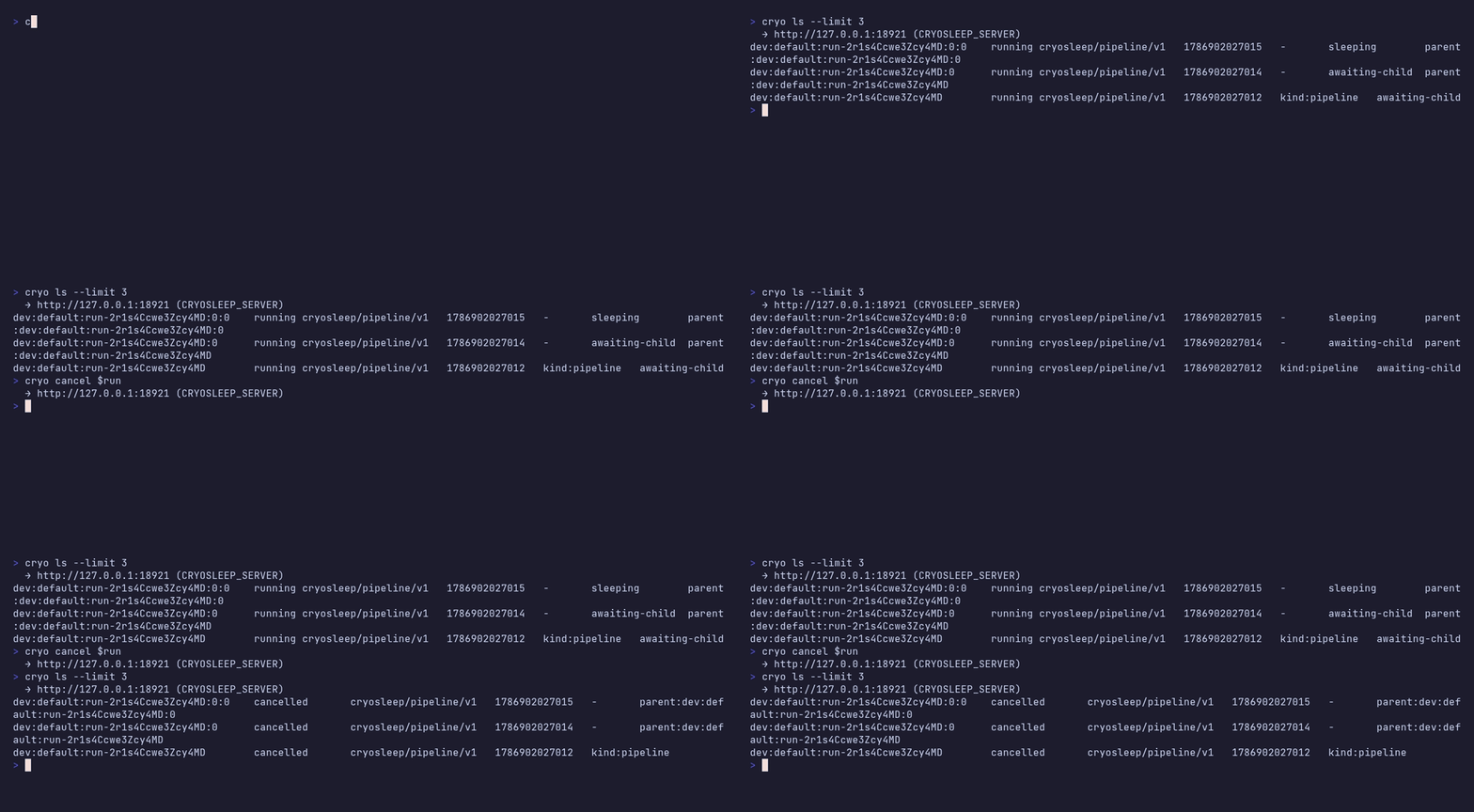
A run that reaches a terminal state cancels every child it was still
waiting on. That is the workflow: job, the workflow node, and
cryo call graph / cryo call node - everything the parent suspends
for. Their result has nowhere to go once the parent has stopped, and
until they notice they keep an agent claimed and hold whatever lease
their jobs took.
It applies to any terminal outcome, not only to cryo cancel: a run
that fails on one branch while another waits on a child leaves the same
orphan. Each cancelled child does the same for its own children, so a
cancel_on: event or one cryo cancel reaches the whole tree. A child
stopped this way records parent <run-id> is no longer running as its
reason.
The child’s own page says why it stopped, so a run nobody submitted and nobody cancelled by hand still explains itself:

Polyglot fan-out children go too. A cancelled run’s
cryo activity-submit children are purged from the dispatch queue with
its own activities, so a cancelled batch stops occupying agents instead
of working through the rest of its list. One consequence to expect: a
purged child never reports, so cryo activities <run-id> shows it as
running from then on - the run is over, and nothing will come back to
say what it was doing.
cryo spawn children are not cancelled. Spawning is
fire-and-forget - a dispatcher that starts a hundred pipelines and exits
is the point of the verb - so a spawned run outlives its spawner. Cancel
one directly if you want it stopped.
Children that already finished are left alone, so cancelling a mostly-done run doesn’t rewrite what its completed steps recorded.
When an agent dies
Section titled “When an agent dies”An in-flight activity holds a 30-second lease. If the agent stops
renewing it (crash, network partition, kill), the lease expires, the
activity returns to the queue, and another capable agent claims it. The
activity re-runs from the start. Completed cryo step boundaries return
their cached output on replay, so the re-run skips work already done.
An agent run with cryo agent run also caps any single activity at one
hour. A job that wedges past that ceiling is abandoned so it can’t hold
the agent’s sequential claim slot forever.
When the server dies
Section titled “When the server dies”The event log is durable. On restart the server picks up every run that
had not reached a terminal status and continues it from its recorded
history, with no operator action. A run that was mid-activity resumes
waiting on that activity; a parked cryo sleep or cryo wait-signal
resumes parked.
Terminal runs are never resurrected. Resume scans the whole log to
classify a run, so a completed, failed, or cancelled run stays
terminal across restarts even if stray queue rows remain.
Retries and timeouts
Section titled “Retries and timeouts”Two kinds of failure recovery, and they don’t overlap.
Infrastructure failure recovers automatically - no config. If an
agent or the server dies mid-run (the two sections above), the run is
re-dispatched and replays from the log. Completed cryo step /
stepFn boundaries return their recorded results instead of re-running,
so recovery is cheap and only the unfinished tail re-executes. You don’t
ask for this and can’t turn it off; it’s what “durable” means here.
A step that fails is your result, and it isn’t retried unless you say so. When a command exits non-zero, that’s a workflow-level outcome - the run fails at that job. Cryosleep doesn’t silently re-run it. To retry on failure, opt in:
- YAML
steps:andscript:jobs take aretry:block -attempts(total, including the first) andbackoff(delay before attempt 2, doubling after). See the YAML reference. A run out of attempts fails. - Fan-out activities take
--retriesand--retry-backoffoncryo activity/cryo activity-submit, and--retry-on-exitto narrow which exit codes are worth another attempt. See the CLI reference. Unlike a job, a fan-out child out of attempts does not fail the run by itself: its last attempt’s output and exit code are whatcryo activity-collectreturns, and the calling script decides what that means.
A timeout caps how long one job’s activity may run. A job’s
timeout: (humantime) overrides the agent’s default ceiling (one hour
on an agent started with cryo agent run; the in-process agents behind
cryo run / cryo dev don’t apply it). On expiry the agent kills the
job’s process group and the activity fails - which then feeds retry:
if set.
What durability does not do: it won’t turn a failing command into a success by replaying it, and it won’t retry your logic on a non-zero exit. Replay re-runs the program and serves completed steps from the log; retries (when you ask for them) re-run the failed unit; timeouts bound a stuck one. A determinism violation between steps fails loudly rather than being retried, because replaying it would fail the same way.
Reconcile sweep
Section titled “Reconcile sweep”Appending a run’s terminal event and purging its queue rows are two separate steps. A crash between them could leave queue rows behind for a run that’s already terminal. A reconcile sweep closes that window: it runs once at startup and then on a slow cadence, purging queue rows whose owning run has reached a terminal status. Combined with cancel’s own purge, an already-finished run can’t keep re-dispatching activities.
Retention
Section titled “Retention”Finished runs don’t live forever. An hourly sweep deletes terminal runs - with their full history, logs metadata, and annotations - once they’re older than the retention window, and bus events past their own window. Running runs are never touched, however old; a six-month soak is safe. Age counts from when the run finished, not from when it was submitted.
How long runs are kept is set per org, and comes from the first of
these that applies: a window pinned on the org, the org’s plan, then
the server-wide default (CRYOSLEEP_RETENTION_RUNS, 90 days, or off
to keep everything). Bus events follow the server-wide
CRYOSLEEP_RETENTION_EVENTS alone, 30 days by default. Both take
humantime values.